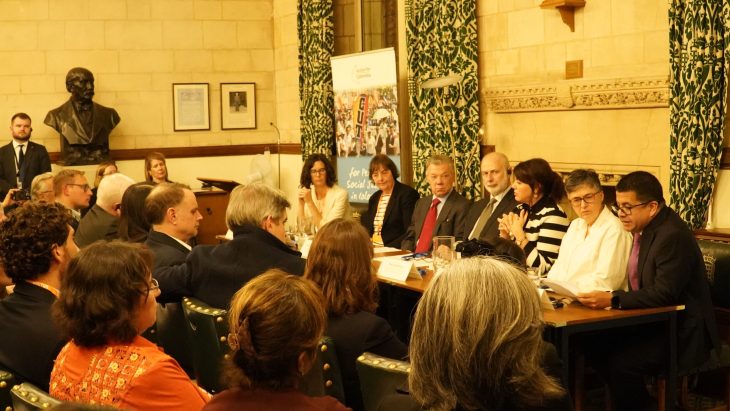

Parliament, London · October 28, 2026. Diego Martínez, member of the legal commission in the Havana peace negotiations, human rights defence lawyer, and consultant on peace.
Honourable members of Parliament; Mr. President Juan Manuel Santos; dear Marcela; dear Mariela Kohon [JFC vice-chair and former JFC director]; Louise from ABC Colombia; ladies and gentlemen:
Allow me to provide a perspective from the standpoint of having worked for the implementation of peace for over 10 years. I do so as someone who helped legally construct that justice in Havana and has accompanied communities in the territories and the peace signatories in this important effort ever since.
A few weeks ago, Fernando Botero’s peace dove—the sculpture that President Santos unveiled at the Casa de Nariño presidential palace in September 2016—fell from its pedestal in the National Museum. It had been removed from the presidential palace at the end of July with the arrival of a new government. It did not break, because it is made of solid bronze, but it was damaged.
No single symbol explains a political process on its own. But few images better summarize the current moment of peace in Colombia. The Agreement overcame the defeat of the plebiscite [in 2016] and was amended to include proposals of the “No” vote. Today, it has been removed from the centre of power, and rests on supports more fragile than we believed, supports that urgently need to be restored.
My thesis is this: ten years on, the principal achievement of the Agreement is of having created an institutional architecture capable of transforming the conflict and changing the culture of violence into political participation, truth, justice, and the hard work towards non-repetition. That architecture is currently going through its most dangerous moment, as attempts are being made to dismantle it.
Implementation advanced in what depended on the word of the [signatories] parties and lagged behind in what depended on the State. According to the Kroc Institute, 36% of the 578 provisions have been fully fulfilled, but nearly 43% remain in a minimal state or unstarted. In 2025, more land was allocated through the Land Fund than in the previous eight years combined. According to the previous government’s official report, more than two million hectares [of land] were formalized, and our Constitution recognized the peasantry as a subject of special protection. Land was finally beginning to reach the [people of] the countryside.
In view of this panorama, one statement can be sustained with evidence: the signatories fulfilled their commitments.
They fulfilled their disarmament: more than fourteen thousand people were accredited. And they fulfilled reintegration: three out of four remain in the process today, including more than three thousand women. In 2025 alone, more than six hundred signatories obtained their high school diplomas. People who spent their youth at war are today finishing school.
They fulfilled on political participation by standing for election. With the assets they handed over 2,356 victims have been repaired. And they appeared before justice: talking to the Truth Commission (CE) and the JEP (Special Jurisdiction for Peace), they also carried out 22 public acts of recognition and 235 legally certified restorative works, projects, and activities across the country.
69% of those appearing before the JEP are former members of the FARC-EP, nearly 30% are members of the Public Force, and barely 1.3% are third-party civilians or non-military members of the State. And it was the former guerrilla leadership that acknowledged their responsibility to the victims as the primary party responsible for kidnapping and accepted the first sanctions of the system. To this day that gesture has no equivalent at the highest levels of command and decision-making within the State.
However, those who fulfilled their commitment [to peace] have not been protected: the United Nations has verified 501 murdered ex-combatants, 185 attempted homicides, and 56 forced disappearances. Compliance has not been enough to ensure survival.
And now I must state this clearly before this Parliament: the current Colombian government is not reviewing the Agreement; it is dismantling it. Competing for the votes and favour of sectors that never supported peace, its desire is to put an end to the Peace Agreement.
As president-elect, current President Dr. Abelardo de la Espriella called the former commanders now appearing before justice “narco-terrorists” and “savages”; he proclaimed “there will be no forgiveness or forgetting” and announced that he will work to ensure former FARC chief Rodrigo Londoño spends “life in prison.” Rodrigo Londoño was already tried and sanctioned by the JEP. Promising to change the rules for someone who confessed and complied is not justice: it is ignoring the word of the State.
Words were followed by deeds. The Government suspended for ninety days any new measure of land delivery, restitution, and formalization, just when land allocation was beginning to accelerate. It asked the [UN] Security Council to remove the rural reform from United Nations Mission of Verification mandate. And it supported the budget cut to the JEP that Congress approved a week ago: a 22% cut to its planned budget. Meanwhile, a bill is moving through Congress to close it down in 2028, without extension: five years ahead of the deadline set by the Constitution, alongside a bill to shield top officials from their responsibilities.
That same budget reduces resources for the agency that accompanies reintegration. More than eight thousand signatories today depend on a basic income equivalent to 90% of a minimum wage. Whoever defunds reintegration is not saving money: they are feeding the recruitment of dissidents.
Let us be fair: the previous government made contributions in land and labour rights, but its peace policy failed to contain dissident armed groups who murder signatories. The current government goes further: it turns abandonment into policy.
Reading peace solely through the lens of security and “terrorism” confuses the symptom with the cause. The continued violence is not a product of the Agreement; it is the consequence of the State failing to reach the territories that the FARC left behind.
Regarding justice: The JEP is the judicial component of the Comprehensive System for Truth, Justice, Reparation, and Non-Repetition. The Agreement created an extrajudicial component: the Search Unit for Persons Deemed Missing, currently affected by budget cuts, and the Commission for the Clarification of the Truth—both non-judicial bodies, the latter of which has already fulfilled its mandate.
The judicial component of the System is the JEP: it concentrates criminal prosecution on those most responsible for the most serious and representative events of the conflict. In exchange for truth and the acknowledgment of responsibility, the parties agreed to a restorative justice that does not renounce sanctions. Those who were in charge who confess receive five to eight years of effective restriction of liberties with restorative labour; those who confess late, before sentencing, receive five to eight years in prison; and those who do not confess and are sentenced at trial face up to twenty years.
The JEP has formulated 420 indictments against top leaders of the FARC-EP, the Public Force, and third parties. Of those that have already reached the acknowledgment stage, more than 91% resulted in an acknowledgment of truth and responsibility: 245. In 2025, it issued its first sentences against the former Secretariat and military personnel, both confirmed after appeal in July of this year.
The JEP agreed upon in Havana is not the same one that was implemented, and indeed it has difficulties that must be assessed and improved by this court, to bring it closer once again to what the parties agreed upon. But when a sanction cannot be enforced because the State offers neither security nor resources, that impossibility cannot be blamed on the person appearing before the court.
Why is the JEP attacked? Because it is the place where legal truth is established regarding the most serious crimes, among them the misnamed “false positives”: 6,402 victims between 2002 and 2008, a figure that could increase. The former FARC leadership has already assumed responsibility for several crimes, including the recruitment of minors and kidnapping. In the time remaining, the jurisdiction is tasked with clarifying other responsibilities, including those at the highest levels of the State, which until now have not been investigated. Testimonies given before the JEP link these practices to the results-focused policies of those years. The fact that pressure is concentrated precisely on this truth speaks volumes. A defunded JEP does not punish the signatories, who have already been sanctioned – it protects those who have not yet assumed their responsibilities.
There is an issue that rarely reaches international forums: the middle level [FARC] commanders. It was they who led their units to lay down their arms. More than nine thousand unselected participants are still awaiting a legal decision [on their status], and it is necessary to resolve this to avoid repeating the consequences of the conflict.
However, I want to acknowledge a group of military personnel who have decided to contribute truth and commit to restorative actions before the JEP. Their truth will be necessary to establish ultimate responsibilities. Important decisions regarding crimes committed by State agents in various macro-cases are approaching, and there is a strong intention to halt the jurisdiction and avoid its conclusions. Those who attack it today know that it is protected by a robust legal framework. They do not seek to destroy it; they seek to intimidate its judicial autonomy and render it ineffective.
Of course, I want to recognize the commitment of all victims in Colombia for their effort and tenacity. Their pain is our hope.
The Colombian constitution mandates all authorities to fulfil in good faith what was agreed upon over three presidential terms. The current one is the last one. The risk is not an open repeal of the agreement: it is the silent dilution of an agreement that remains in force on paper but is weakened, alongside the suspension of programs and the suppression of institutions.
I propose five priorities. Protect life by dismantling the structures that carry out attacks: out of 110 convictions for attacks against ex-combatants, only five reach the masterminds.
Lift the suspension of land measures. Guarantee resources for reintegration.
Ensure the judicial autonomy of the JEP in accordance with what was established in Havana, with the commitment to complete its tasks with a closure plan for the victims and legal security for those who appear before the court, without stigmatizing judges, victims, and participants. And finally, sustain the international accompaniment [of the peace].
That is why I address this Parliament and Europe. The United Kingdom, which is the penholder for resolutions on Colombia in the United Nations Security Council, has been, alongside the European Union, a permanent companion to this process. And the British and Irish trade union movement, through Justice for Colombia, has accompanied the signatories for years, even bringing the experience of the Good Friday Agreement to the negotiators. Thank you, Mariela, for that commitment.
In a world where wars are multiplying, Colombia showed that parties to a conflict could acknowledge their crimes before the victims and initiate a restorative justice process. It demonstrated that a negotiated transitional justice is possible, in which those responsible for the most serious crimes are sanctioned, and in which all, including high state authorities, are called upon to assume their responsibility. If that model fails by decision of a government, the message for any future negotiation in the world will be devastating: that the word of a State does not survive a change of president.
Like Botero’s sculpture, the Agreement did not break when it fell. It is wounded, and it must be restored with patience, skill, and political will. The signatories fulfilled their part. The question is not whether they will comply – it is whether the Colombian State will fulfil its obligations to them, to the victims, and to the territories.
Thank you very much.