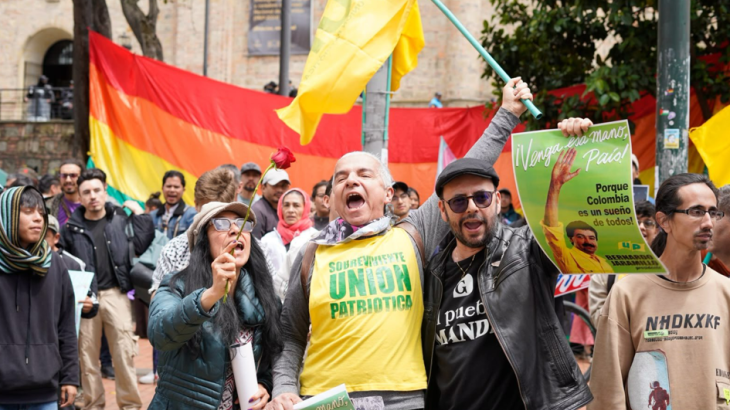

Colombia’s far-right government has sparked protests and fierce criticism after ordering the removal of more than 30 exhibits and artifacts relating to peace, political violence and social rights from the National Museum in Bogota, the largest and oldest museum in the country. Tensions grew worse when authorities, rather than engage in dialogue over accusations of ‘erasure of history,’ deployed riot police to repress a peaceful protest outside the museum on consecutive days over 17-18 October.
Where exhibits relating to the 2016 peace agreement, state-backed violence against the Patriotic Union political party and the struggle for LGBTQ rights were previously on public display, visitors to the museum are now presented with empty gallery spaces. The pieces were suddenly removed from the museum’s ‘Hacer Sociedad’ (Make Society) and ‘Memoria y Nación’ (Memory and Nation) sections on 15 October. Museum employees told press that cultural minister Julián Sterling toured the exhibits alongside museum director Constanza Toquica and pointed out which pieces were to be removed. Such decisions are supposed to be taken by the museum’s curatorial committee, according to the unnamed workers.
It is the latest attempt by Colombia’s political right to control narratives and public understanding of historic conflict, state repression and social struggle. Since taking office, President De la Espriella has renamed the Ministry of Culture, Art and Knowledge to the Ministry of Art and Patrimony, while also instructing cultural minister Paola Holguín to remove references to guerrilla armed struggle from public spaces, labelling this as ‘terrorism.’
Among the historical figures erased from museum displays are UP senator Bernardo Jaramillo and leader of the M19 guerrilla movement Carlos Pizarro, who were both assassinated a little over one month apart in 1990 while standing in that year’s presidential election. At least ten items relating to LGBTQ and feminist organising in Colombia were removed. Others were taken from an exhibit tracking historical lineage from the 1991 constitution to the 2016 peace agreement, with the pen used to sign the agreement among them. Other items removed include UP election campaign posters, feminist movement posters, a painting titled ‘Minería’ (Mining) by artist Antonio Caro and photographs of gay pride marches.
Carlos Pizarro’s daughter, Historic Pact senator María José Pizarro, led condemnation of the government’s actions. Her father is, she said, ‘more alive than ever, and Abelardo [de la Espriella]’s attempt to proscribe his memory and his figure is only making his legacy of peace even greater,’ she said. She subsequently posted that Facebook was restricting her posts on the issue.
Former president Gustavo Petro wrote on X that ‘[i]t’s called censorship and looting of a museum.’ Opposition to the government’s actions spanned beyond the progressive left, with another former president, centrist Juan Manuel Santos, whose government signed the 2016 agreement, posting that ‘history and memory of a country cannot be erased. On the contrary, they are protected and used to unite us as a nation, not divide us.’
In response to the criticism, culture minister Holguín said museums should not serve as ‘instruments of political indoctrination’ and that children should not view ‘sensitive material,’ without clarifying what exhibits she was referring to. She also implied other cultural spaces were under review. Holguín belongs to the hard-right Democratic Centre (CD) party, which has long opposed campaigns to commemorate decades of conflict. The move has even sparked opposition within the right, with the vice-presidential candidate for the CD, Juan Daniel Oviedo, countering Holguín by arguing the struggle for LGBTQ equal rights was part of national history.
Built in 1872 as the Panóptico prison, the vast stone building reopened as the National Museum in 1948. It houses more than 20,000 items including historical artifacts, artworks, archaeological samples and other items dating from prehistoric times to the modern era. It is one of Colombia’s most visited cultural institutions.
On Saturday 17 October, more than 500 people gathered peacefully outside the National Museum to protest the exhibits’ removal. Some held reproduced versions of the removed items. ‘If they remove 30 pieces, we’re going to paint them – as often as we possibly can – in the street,’ one student said. Riot police used water cannon and stun grenades to disperse the crowd, badly damaging the historical memory monument in front of the museum. Further repression took place the following day. Senator Pizarro called the police treatment of protesters ‘absurd, unjustified and disproportionate.’
The police’s heavy-handed approach came days after De la Espriella issued a decree to permit stronger force against protests. Historic Pact congress member Mafe Carrascal, who took part in the protest outside the museum, said she would challenge the new police powers. The Permanent Committee on Human Rights (CPDH) said ‘we denounce the disproportionate use of force, intimidations and raids by the Public Force [police] against human rights defenders and citizens.’
Under the right-wing governments of Álvaro Uribe (2002-10) and Iván Duque (2018-22), Colombia saw strong efforts to control political narratives from above. Both administrations made political appointments to key roles such as the National Centre of Historic Memory, the state archive on historic violence. State discourse claimed that Colombia did not experience an armed conflict but rather was subjected to ‘terrorism.’ Such denial reframes state violence as necessary to protect the nation and ignores the state’s historical role in the targeting of political movements. In that framing, the repression – which saw many thousands of trade unionists, activists, campesinos and students murdered, stigmatised, threatened and imprisoned – is recast as a noble defence of the population.
Last week, De la Espriella announced a ‘cultural counterrevolution’ against ‘wokeism’ within the state. Colombia’s president is implementing a policy of historical erasure by physically restricting what the public can access. The museum dispute seems to be only the beginning.